

Health & Nutrition
3 min to read
Maintaining your OTT's condition
Learn how to monitor your Thoroughbred’s body condition after racing, adjust feeding and recognise when to seek nutrition or veterinary advice.
Health & Nutrition
How to Assess Your Horse’s Body Condition
Maintaining a healthy body condition is an important part of responsible horse ownership. Whether your Thoroughbred is transitioning from racing, enjoying retirement or beginning a new equestrian career, regularly assessing their condition can help you identify changes in their health and wellbeing.
Body Condition Scoring (BCS) is a simple, practical way to assess the amount of fat covering a horse's body. It can help you determine whether your horse is underweight, carrying an appropriate amount of condition or overweight.
The Body Condition Scoring system uses a scale from 0 (emaciated) to 5 (obese), based on the amount of fat covering key areas of the horse's body.
Different horses will have different ideal body conditions depending on their age, breed, workload and stage of life.
For Thoroughbreds, a score of 2–3 is generally considered appropriate, with a score of 2 often suitable for fit racehorses and performance horses, while a score of 3 is typically more appropriate for horses in leisure work or retirement.
BCS 0 – Emaciated
The horse is extremely thin, with clearly visible ribs, spine, pelvis and hip bones. There is virtually no fat coverage, and the rump appears very sunken. This condition requires urgent veterinary attention.
BCS 1 – Poor
The horse is noticeably underweight. Ribs are clearly visible, the spine and pelvis are prominent, and there is very little fat coverage over the body.
BCS 2 – Moderate
The horse has a lean but healthy appearance. Ribs may be just visible, the neck is narrow but firm, and the spine is well covered. This condition is often suitable for fit racehorses and performance horses.
BCS 3 – Good
The horse has a well-rounded appearance without excess fat. Ribs are covered but easily felt, the neck is firm, and the pelvis is smoothly rounded. This is generally an appropriate condition for most leisure and retired Thoroughbreds.
BCS 4 – Fat
The horse is carrying excess condition. Ribs are difficult to feel, the neck may develop a fatty crest, and fat deposits may be noticeable along the back and around the tailhead.
BCS 5 – Obese
The horse has excessive fat coverage, with a thickened neck, deeply buried ribs and significant fat deposits along the back and hindquarters. This condition increases the risk of health complications.
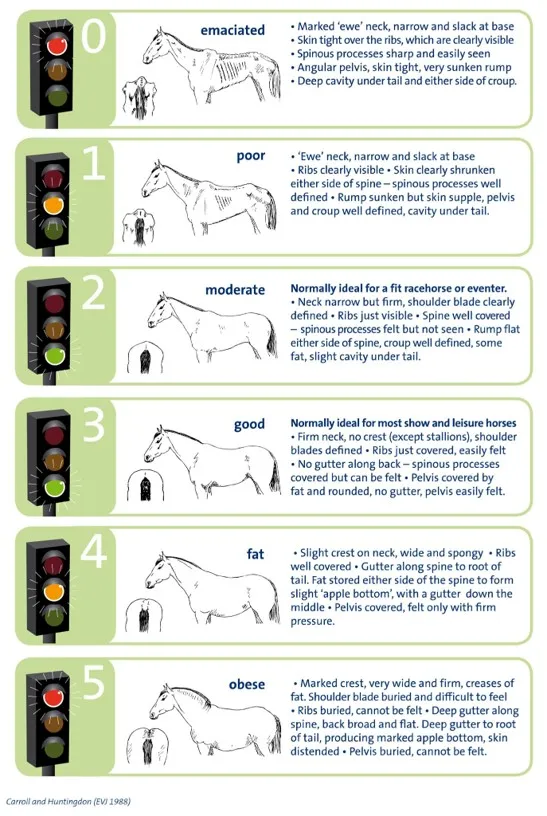
Body Condition Scoring involves both looking at and feeling your horse. Fat coverage is not always obvious from appearance alone, particularly in horses with thick coats or well-developed muscle.
When assessing your horse, pay particular attention to:
Use the Body Condition Scoring chart as a visual guide and select the score that most closely reflects your horse's overall condition.
A Thoroughbred's body condition can change significantly during the transition from racing to a new home or career. Changes in workload, diet, turnout and management can all influence weight and muscle development.
We recommend assessing and recording your horse's body condition regularly, particularly during the first few months after racing.
Taking photographs from the same angles and recording body condition scores over time can help you identify gradual changes that might otherwise go unnoticed.
Remember: Body Condition Scoring measures fat coverage, not muscle development. A horse may have an appropriate body condition score but still need time to develop topline and muscle through appropriate nutrition, exercise and training.
If your horse is losing weight unexpectedly, struggling to maintain condition or carrying excessive fat, consult your veterinarian or a qualified equine nutritionist.
Sudden changes in body condition can indicate underlying health or management issues and should not be overlooked.
A healthy Thoroughbred is not necessarily a round Thoroughbred. The goal is to maintain an appropriate body condition for your horse's individual needs, supporting their long-term health, comfort and wellbeing.
Body Condition Scoring reference: Carroll and Huntington (1988), 0–5 scale.
Share
Email
Health & Nutrition
3 min to read
Learn how to monitor your Thoroughbred’s body condition after racing, adjust feeding and recognise when to seek nutrition or veterinary advice.

Health & Nutrition
5 min to read
Learn how to build a forage-first diet, transition feed gradually and monitor your Thoroughbred’s condition, water intake and changing workload.